

1967 Omega De Ville Automatic 'Tank' Andrew Grima 24x39mm 551.074
Read more...




More Information
Description
More
Less
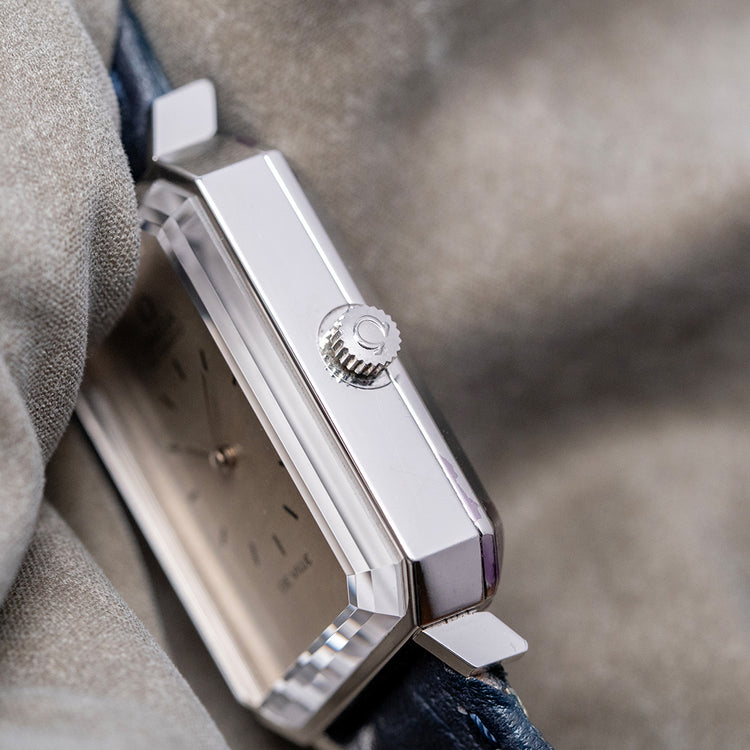
Here we have a rare 1967 Omega De Ville Automatic 'Tank' Andrew Grima, reference 551.074. Andrew Grima, born in 1921, was a well-known Anglo-Italian jewellery designer. He is often called the "father of modern jewellery" because he changed the way jewellery was made after World War II, introducing bold and artistic designs that stood out. He worked with Omega to create a unique collection called "About Time," featuring cases crafted from semi-precious stones rather than glass. Grima attracted many famous clients, including Queen Elizabeth II, Princess Margaret, Jacqueline Kennedy Onassis, and actress Ursula Andress. Andrew Grima passed away in 2007, leaving behind a legacy of innovative and striking jewellery designs. In 1967, the De Ville became its own standalone collection, praised for its sophisticated and refined aesthetic, and its success led to it becoming a separate, best-selling line for Omega. Featuring an Andrew Grima 24mm tank-shaped stainless steel case that sits comfortably on your wrist with fine flat-ended lugs. Its perfect angular corners and straight flanks lead to a lug-to-lug length of 39mm and a case thickness of 11mm. On the right side, a slim coin-edged crown. A beautiful, multifaceted mineral crystal sits proudly atop the brushed silver dial. Slender hour markers surround elegant steel hands in the centre. At noon, we have the printed Omega ‘Automatic’ motif, and at 6 o’clock, the De Ville logo completes this sophisticated, minimalist jewel-like timepiece. On the reverse, a snap-off stainless steel case back, inside an automatic Omega Cal. 661, 24 jewels, beating at 19,800 beats per hour, produced from 1961 until 1973. It comes paired with a well-suited 14mm short strap and pin buckle.
Points of Mention
More
Less
Personal Note
More
Less
Specification
More
Less
Movement : Automatic Omega Cal. 661
Age : Circa. 1967
Year : 1967
Case Size : 41mm
Case Thickness : 12.5mm
Lug to Lug : 39mm
Lugs : 14mm
Condition : Pre-Owned
Box and Papers : None
Case Material : Stainless Steel
Warranty : 12-Months NON-Waterproof Warranty
The wrist model's wrist size is 7inch
About Omega
More
Less
Description
Here we have a rare 1967 Omega De Ville Automatic 'Tank' Andrew Grima, reference 551.074. Andrew Grima, born in 1921, was a well-known Anglo-Italian jewellery designer. He is often called the "father of modern jewellery" because he changed the way jewellery was made after World War II, introducing bold and artistic designs that stood out. He worked with Omega to create a unique collection called "About Time," featuring cases crafted from semi-precious stones rather than glass. Grima attracted many famous clients, including Queen Elizabeth II, Princess Margaret, Jacqueline Kennedy Onassis, and actress Ursula Andress. Andrew Grima passed away in 2007, leaving behind a legacy of innovative and striking jewellery designs. In 1967, the De Ville became its own standalone collection, praised for its sophisticated and refined aesthetic, and its success led to it becoming a separate, best-selling line for Omega. Featuring an Andrew Grima 24mm tank-shaped stainless steel case that sits comfortably on your wrist with fine flat-ended lugs. Its perfect angular corners and straight flanks lead to a lug-to-lug length of 39mm and a case thickness of 11mm. On the right side, a slim coin-edged crown. A beautiful, multifaceted mineral crystal sits proudly atop the brushed silver dial. Slender hour markers surround elegant steel hands in the centre. At noon, we have the printed Omega ‘Automatic’ motif, and at 6 o’clock, the De Ville logo completes this sophisticated, minimalist jewel-like timepiece. On the reverse, a snap-off stainless steel case back, inside an automatic Omega Cal. 661, 24 jewels, beating at 19,800 beats per hour, produced from 1961 until 1973. It comes paired with a well-suited 14mm short strap and pin buckle.
Points of Mention
Personal Note
Specification
The Brand
Enquire or Book an Appointment
Would you like to discover further details about this watch, or perhaps arrange an appointment to view and try it on? Complete this form and a member of our team will get back to you shortly.
You May Also Like