1960s Blancpain Rayville 'Ultra Thin' Steel 34mm

Regular price
£750.00
Sale price
£750.00
Regular price
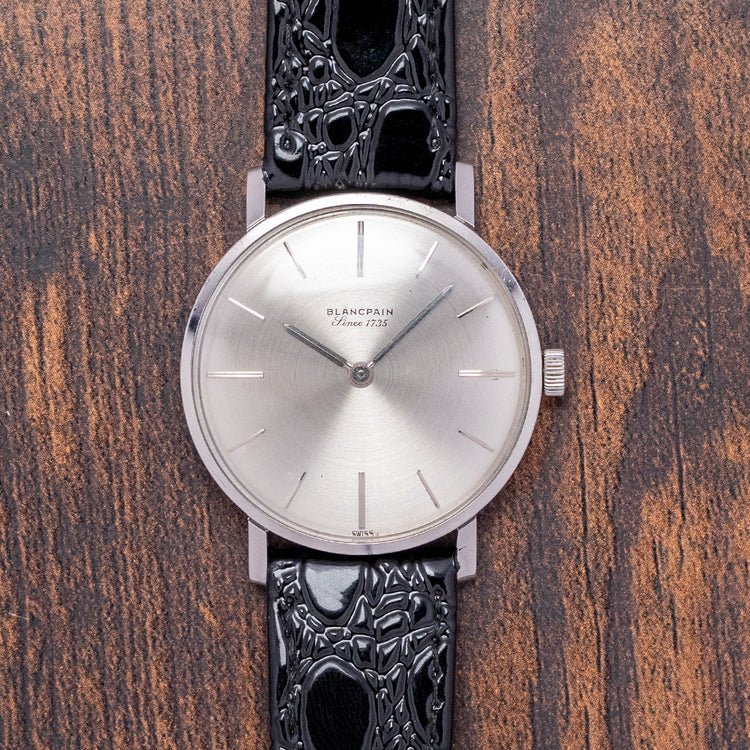
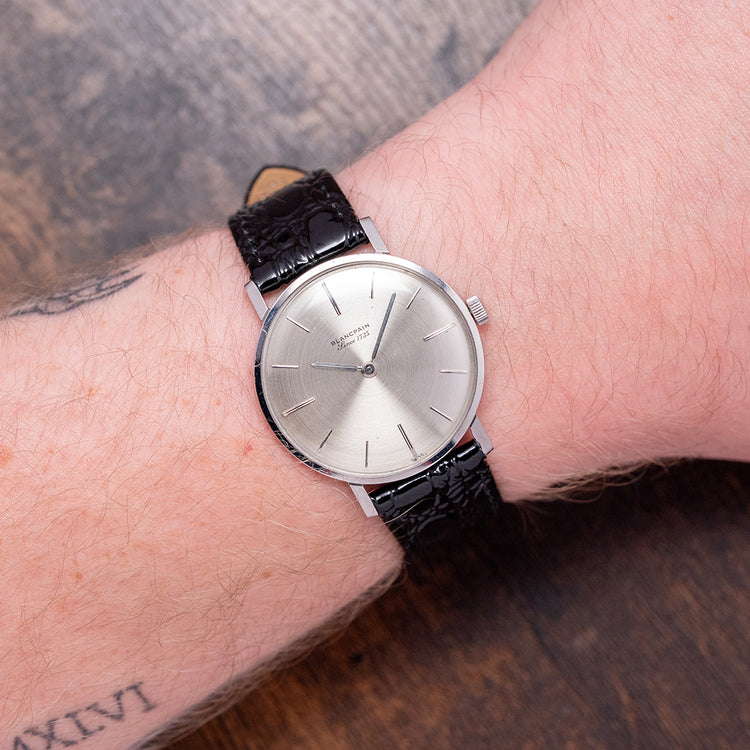
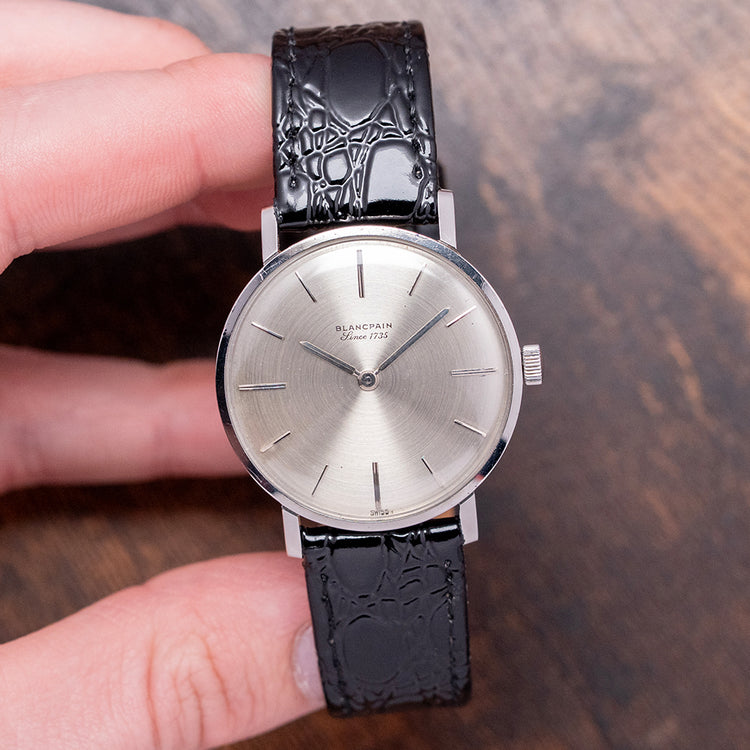
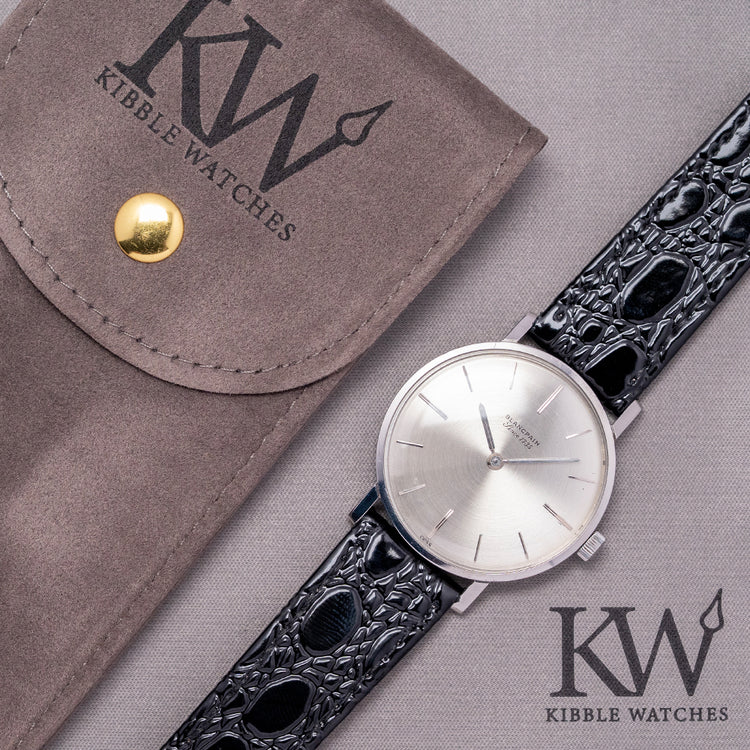
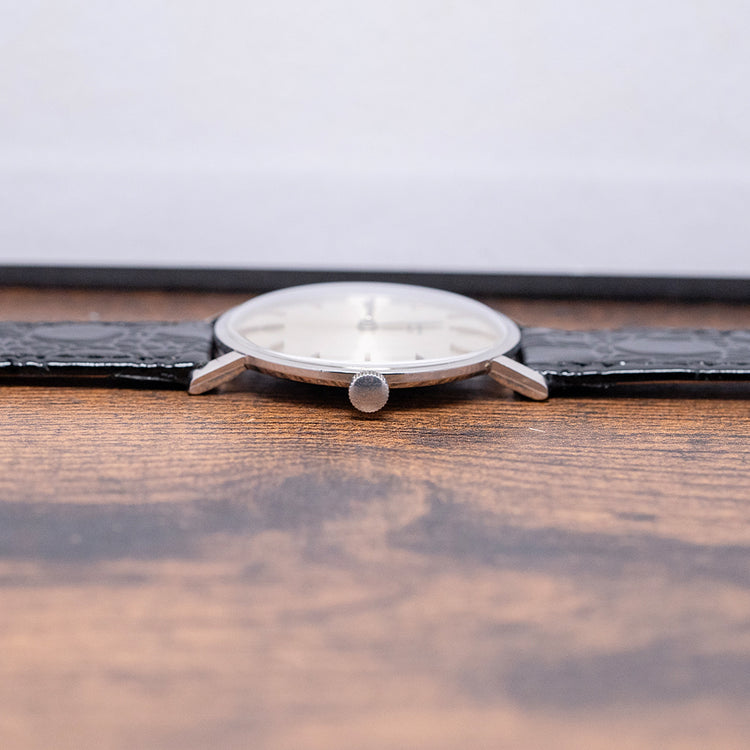
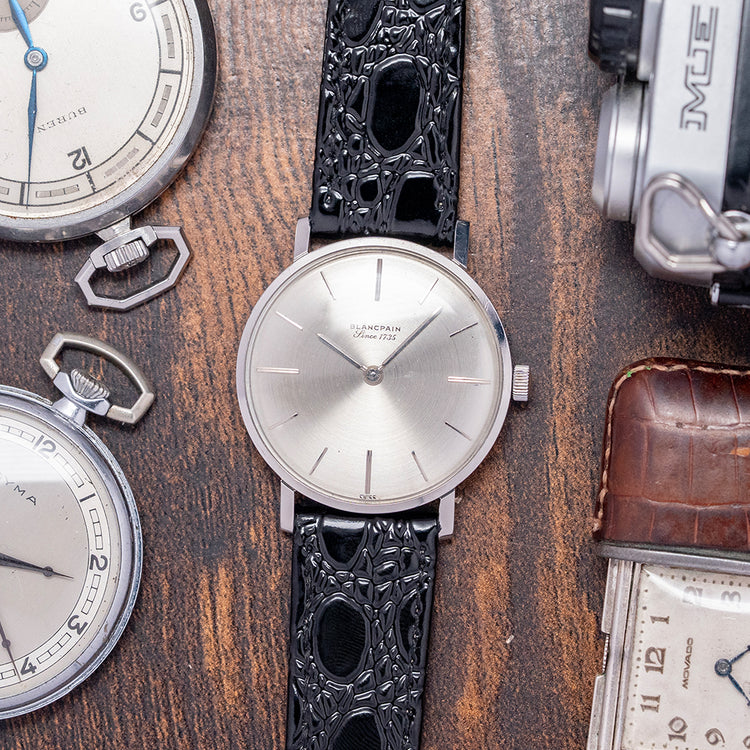
Here we have a 1960s Blancpain Rayville 'Ultra Thin' Steel featuring a curvaceous 34mm stainless steel round case that gently curves over your wrist, thanks to straight lugs. Its slim profile leads to a lug-to-lug length of 40mm, and a case thickness of just 7mm ensures a comfortable fit on your wrist. On the right side, there is a coin-edged crown.

Read more...
View additional images

More Information

Description

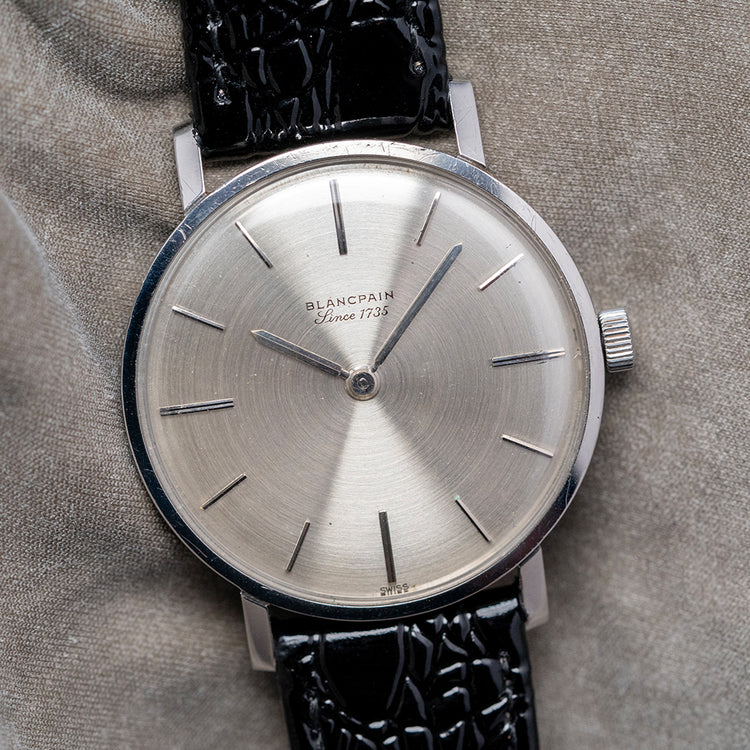
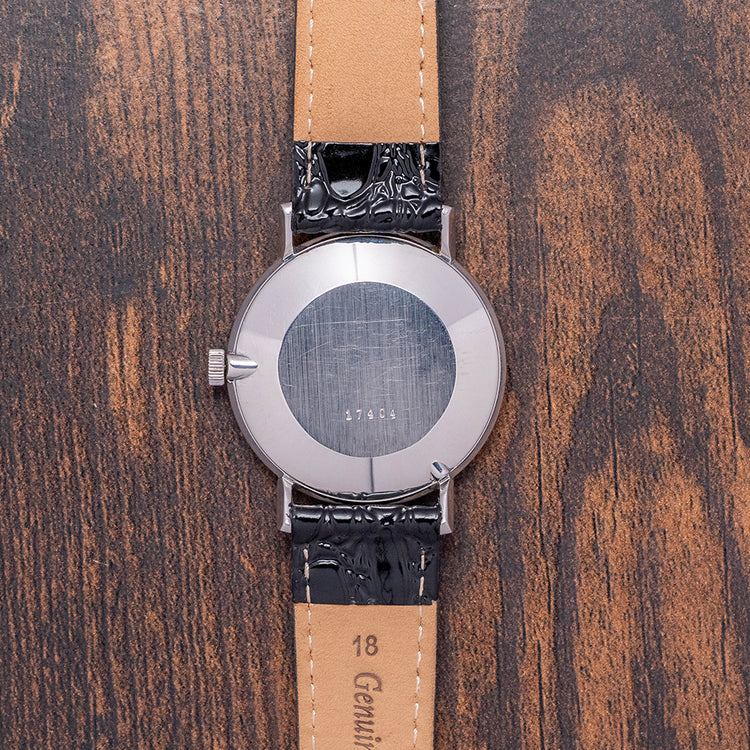
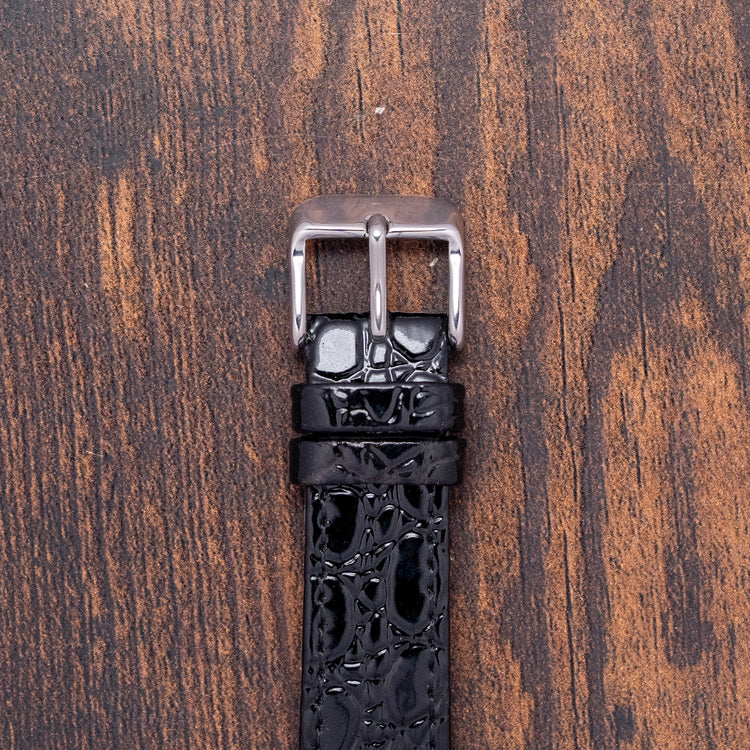
Here we have a 1960s Blancpain Rayville 'Ultra Thin' Steel featuring a curvaceous 34mm stainless steel round case that gently curves over your wrist, thanks to straight lugs. Its slim profile leads to a lug-to-lug length of 40mm, and a case thickness of just 7mm ensures a comfortable fit on your wrist. On the right side, there is a coin-edged crown. A bevel-edged smooth bezel holds a domed crystal above a striking silver engine-turned dial, applied slim baton indexes mark the hours, and elegant hands sit majestically in the centre. At 12 o’clock, the Blancpain motif completes this sophisticated dress watch. On the reverse, a snap-off case back with the details of the watch engraved, inside a manually wound Peseux Cal. 7000, 21 jewels, beating at a leisurely 18,000 beats per hour. The watch comes paired with a well-suited 18mm leather strap and a pin buckle.

Points of Mention

This watch is sold as "Watch Only" and, therefore, comes with no original Blancpain box or paperwork. It is paired with a well-suited 18mm leather strap and pin buckle. The watch is from Circa. 1960s and is sold in worn, vintage condition, but overall, this is an excellent example of this rare reference. The watch comes with our 12-Months NON-Waterproof Warranty.

Personal Note

This is quite a departure from what we think of as Blancpain today, and I absolutely love it. This is an elegant and simple 1960s Blancpain Rayville 'Ultra Thin' in a 34mm stainless steel case, and only 7mm thick, it disappears on the wrist in the best way. The silver spun dial plays with the light, and the simple branding gives an indication that this is something great. I would not hesitate to add this vintage gem to your collection today!

Specification

Reference : 17404
Movement : Manually Wound Peseux Cal. 7000
Age : Circa. 1960s
Year : Circa. 1960s
Case Size : 34mm
Case Thickness : 7mm
Lug to Lug : 40mm
Lugs : 18mm
Condition : Pre-Owned
Box and Papers : None
Case Material : Stainless Steel
Warranty : 12-Months NON-Waterproof Warranty
The wrist model's wrist size is 7inch

About Blancpain

Jehan-Jacques Blancpain founded his watch business in 1735, utilising the upper floor of his farmhouse as a workshop. His son David-Louis Blancpain (1765-1816), was committed to growing his father's business by travelling often through Europe, in particular to France and Germany, selling and delivering Blancpain watches. Frédéric-Louis handed the company to his son, Frédéric-Emile, when he was just 19 years old, due to his bad health. The company became known as 'E. Blancpain’. Emile achieved remarkable success, building the business into the largest and most effective enterprise in Villeret. Frédéric-Emile, the grandson, continued heading the company until 1932. During his later years, he was joined in 1915 by Betty Fiechter, who assisted him in running the business. She joined the company as an apprentice when she was just 16, and quickly her responsibilities at Blancpain grew to become head of manufacturing and commercial development. Frédéric-Emile was so confident in her skills and talent that he started training her for taking on responsibility for production and becoming the director of the company, which is an incredible achievement for a woman during that time period. In 1926, the company entered into a partnership with John Harwood, a British watchmaker who had produced the first self-winding wristwatch, obtaining a Swiss patent in 1924. With Betty Fiechter as the director, Blancpain had to survive the Great Depression of the 1930s. One such way was to open their movement supply to other brands. In this period, Blancpain became a supplier of Gruen, Elgin and Hamilton, among many others. The brand was renamed "Rayville S.A., succ. de Blancpain" in 1932. Betty Fiechter was joined in 1950 by her nephew Jean-Jacques Fiechter, who had a key role in the development of the Fifty Fathoms, the world’s first modern diving watch, which debuted in 1953. Collaborating with the French combat divers, Jean-Jacques promoted its widespread adoption by many navies around the world, as well as being used by the famous explorer Jacques Cousteau and his team. In 1961, Rayville-Blancpain merged into the largest Swiss watch group, the Société Suisse pour l’Industrie Horlogère (SSIH), where they joined Omega, Tissot and Lemania. Inside this Group, they saw huge growth, even building new facilities and production soaring to more than 220,000 pieces by 1971. This growth did not last as a combination of events hit at once. First, we saw the fall of the dollar against the Swiss franc, which reduced their transatlantic exports, and secondly, a serious oil crisis that triggered a worldwide recession, but to top it all, the entire Swiss watchmaking industry was severely hit by the huge growth in imports of quartz watches from Japan, referred to as "the quartz crisis”. A new strategy was seriously needed by the Société Suisse pour l’Industrie Horlogère (SSIH), which decided to build its own quartz watches rather than mechanical ones. In 1993, they sold the Rayville-Blancpain name to Frédéric Piguet, a partnership between Jacques Piguet and Jean-Claude Biver, who was at that time an employee of SSIH. The new company traded under the name of Blancpain SA and set up production in an old building belonging to the Piguet family at Le Brassus, in the Vallée de Joux, Switzerland. In 1991, Blancpain presented the most complicated wristwatch in the world at the time: the 1735 Grande Complication. This incredible timepiece featured a one-minute tourbillon regulator, a perpetual calendar with moon phases and moon age, a co-axial split-seconds chronograph and a minute repeater activated by the slide on the band. It took over ten months of work by a watchmaker master; the Blancpain 1735 Grande Complication had a production run of just 30 pieces from 1991 to 2009. In 1992, the Société Suisse pour l’Industrie Horlogère (SSIH) bought Blancpain SA back for 60 million Swiss Francs (that is more than 1000 times the amount that was paid in 1983 for the brand ). It was during this time that SSIH and ASUAG - the two largest Swiss watch groups - merged into the Swiss Corporation for Microelectronics and Watchmaking Industries Ltd. (SMH). SMH was later renamed The Swatch Group in 1998. Jean-Claude Biver remained CEO of the company until 2003; from then on, Marc A. Hayek has been the CEO.

Description

Here we have a 1960s Blancpain Rayville 'Ultra Thin' Steel featuring a curvaceous 34mm stainless steel round case that gently curves over your wrist, thanks to straight lugs. Its slim profile leads to a lug-to-lug length of 40mm, and a case thickness of just 7mm ensures a comfortable fit on your wrist. On the right side, there is a coin-edged crown. A bevel-edged smooth bezel holds a domed crystal above a striking silver engine-turned dial, applied slim baton indexes mark the hours, and elegant hands sit majestically in the centre. At 12 o’clock, the Blancpain motif completes this sophisticated dress watch. On the reverse, a snap-off case back with the details of the watch engraved, inside a manually wound Peseux Cal. 7000, 21 jewels, beating at a leisurely 18,000 beats per hour. The watch comes paired with a well-suited 18mm leather strap and a pin buckle.

Points of Mention

Personal Note

Specification

The Brand

Enquire or Book an Appointment

Would you like to discover further details about this watch, or perhaps arrange an appointment to view and try it on? Complete this form and a member of our team will get back to you shortly.

By submitting this form, you agree to our Privacy Policy.

You May Also Like